

It was once the royal abode of kings and aristocrats. Then the center of the colonial administration and its defenses. Now, the historic Fort Canning Park in downtown Singapore provides a small space of green relief for dwellers of the adjacent business district and visitors to the National Museum. Meticulously kept lawns blend with historic artifacts and diverse flora in this pleasant, but hardly natural, urban green space.
As a group of elderly residents finishes up their early morning tai-chi practice, my attention is torn. I am admiring not only the graceful arching of backs, limbs, and swords, but also the stoic focus with which they are able to shut out their decidedly loud neighbors cackling above. Those neighbors are a pair of large Oriental Pied hornbills, calling continuously from an overhanging branch.

The scene strikes a chord. Although not rare, this conspicuous and raucous frugivore is typically associated with the edges of lowland tropical rainforests and not an urban park in one of the most densely populated cities in the world. Over the next few days, I have more close-up encounters. All with more wildlife than I could have imagined thriving inside city limits.
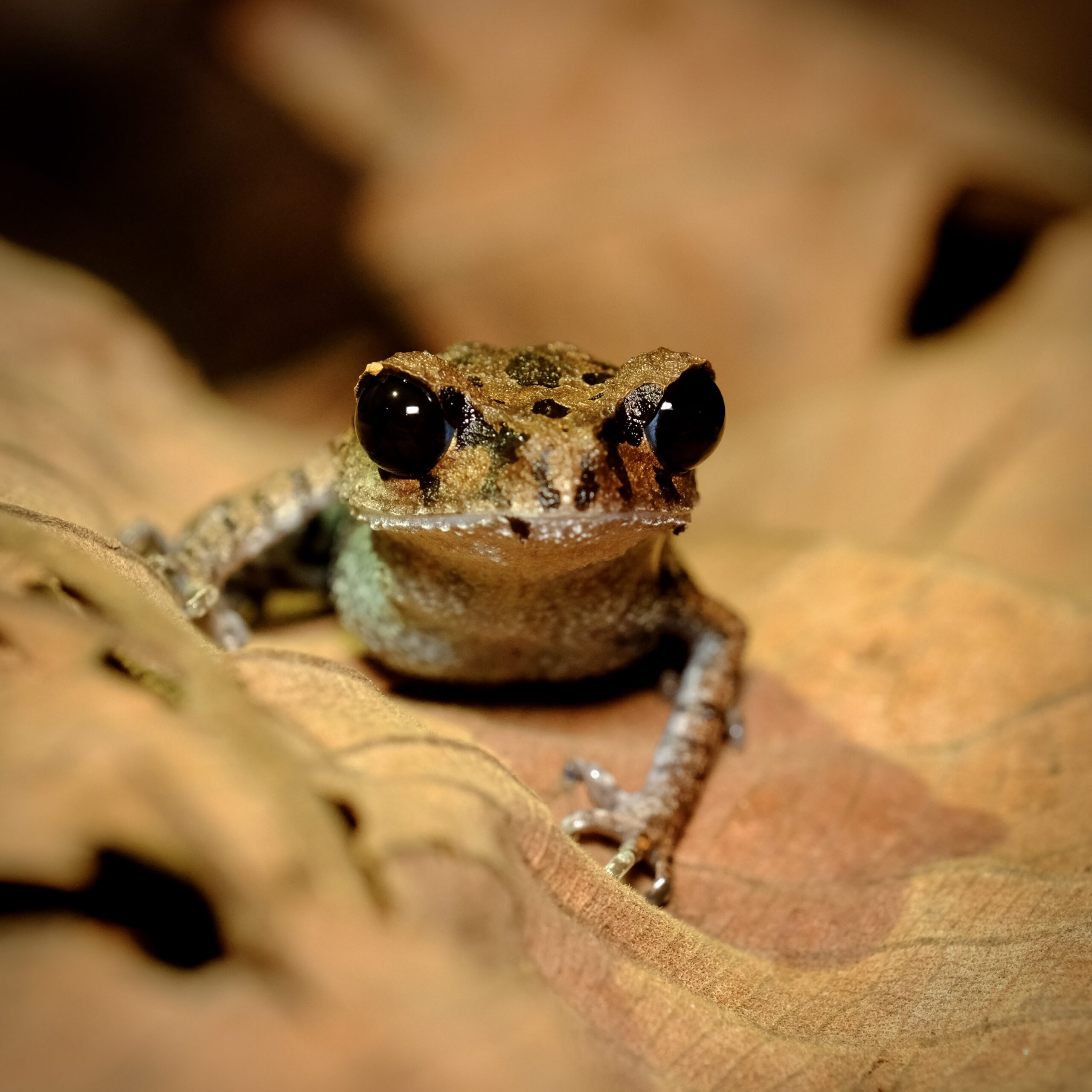
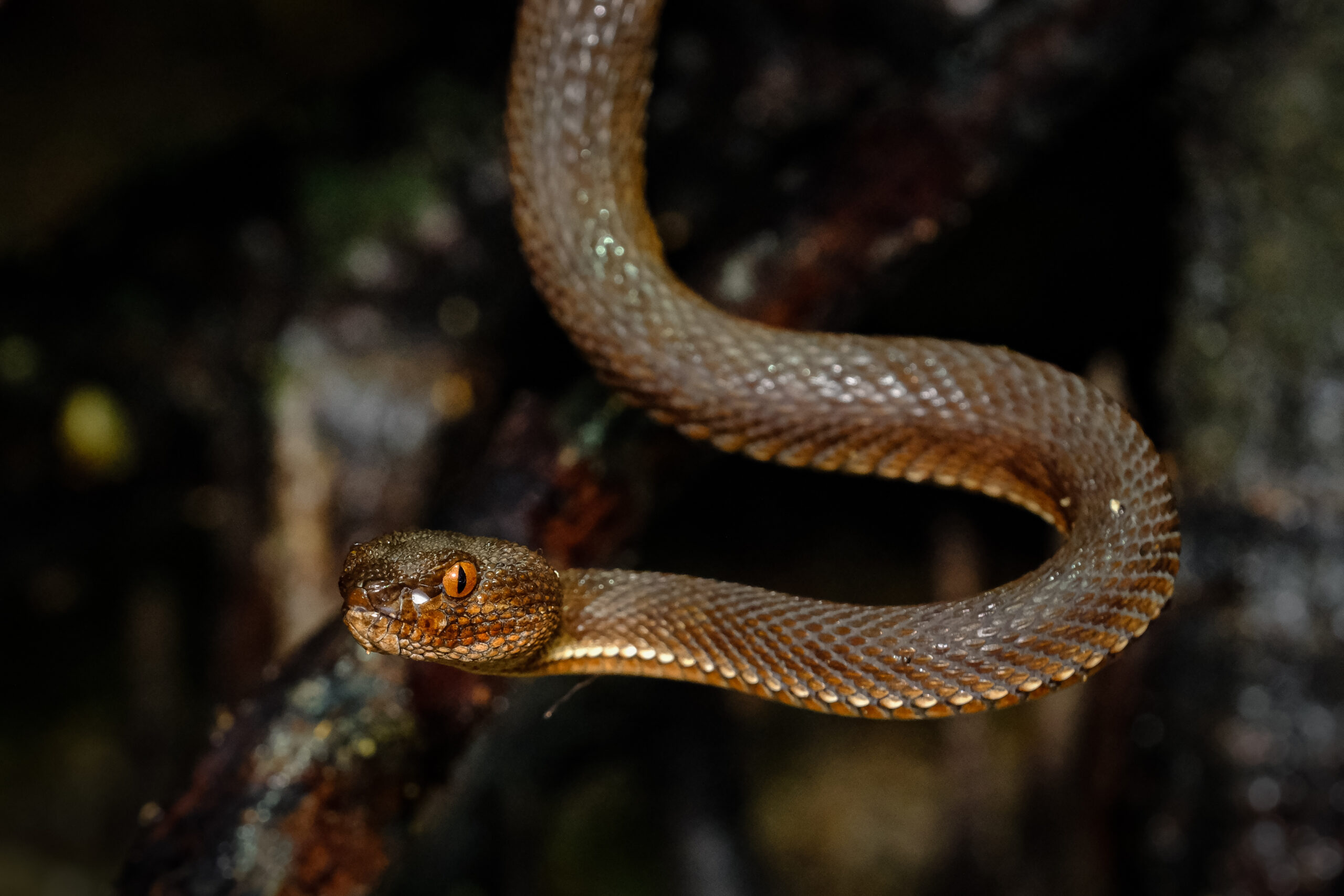
The botanical gardens feature everything from changeable hawk-eagles to stork-billed kingfishers and alarmingly large water monitor lizards who forage unfazed by the tourist crowds. But perhaps the real surprise comes when a local guide takes me along for a nighttime stroll. They point out the rich diversity of frogs and snakes (from harmless to lethally venomous) found along stony dykes and public boardwalks. Not to mention the plethora of lesser mouse deer sharing abandoned car parks at the forest edge. These parks are otherwise mostly known and used by secret lovers.
It is thrilling—and simultaneously somewhat anti-climactic—to have wildlife encounters surrounded by people, cars, roads, and office blocks. Especially when the wildlife itself does not really seem to give a damn about it. I’m forced to reconsider my own assumptions as I explore more of Singapore’s green spaces, particularly the assumption that authentic wildlife encounters can only be experienced in vast and remote areas. These assumptions were formed in no small part by a childhood full of televised wildlife.
Televised Nature
I grew up in an intensively cultivated piece of agricultural land in Europe in the late 1990s: the Dutch Noordoostpolder. But still, I found brief and vicarious escapes from my monocultural rural surroundings by visiting my aunt in the city. Through her cable-television, I had access to around-the-clock wildlife shows.
The shows shared a rather straightforward format. They consisted of sending a 30-something (white) man running or diving around excitedly in search of wildlife in some remote corner of the world. I was in awe of all of them: Aussie legend Steve Irwin, fellow crocodile man Brady Barr, the comical Jeff Corwin, sharkman Ian Gordon—just to name a few.
Paired with hugely successful BBC Earth documentaries, these shows instilled an image of what “true” nature and wildlife encounters should be. Always in vast, remote areas, primarily accessed only by the Western adventurer, and with a good risk of bodily harm thrown in. These archetypical wildlife shows and hosts are still found widely today and remain hugely popular.
It is time to rid ourselves of the notions that the natural world and the wildlife in it exist as a playground for us to conquer.
Nowadays, social media further exacerbates this setup, with a plethora of self-proclaimed experts taking a page from the influencer book. They use the same exploitative model of self-actualization, offering tips and tricks, often as an appetizer to ridiculously expensive workshop itineraries. All with the apparently amiable goal of allowing you to achieve just such a level of unique expertise when it comes to tracking, photographing, or filming of wildlife. Such ventures are typically justified by stating they are really about supporting conservation. But often, they facilitate a semi-permanent traveling lifestyle. This lifestyle comes at considerable cost to the environment, and reduces the cut available to local guides.
Questioning Authenticity
From television to social media reels, the ideal of authenticity being rooted in potentially dangerous adventure persists. Why is it more “real” or “authentic” to stalk rhinos and elephants on foot in the long grass? Why is viewing them on safari considered mass tourism? If wildlife viewing has to be authentic, can we still enjoy it when it starts to break our rules? If it turns up in rather more “mundane” environments that might not accord with what we have taught ourselves to be natural? In our search for thrills, do the bears catching salmon in a remote creek accessible only by seaplane, hyenas spotted after a day of tracking the vast savannah, or a red fox crossing a wintry mountainside, count more than observing the same species thriving on meals scraped together in the suburbs of Anchorage, Addis Ababa, or London?

I have been pursuing these notions of authentic wildlife encounters for most of my adult years. It started from a childhood fascination with the wild things beyond the boundaries of the family farm. Soon, this evolved into an academic career in ecology and conservation. Perhaps I am mistaking personal experience for a broader pattern. But I keep wondering: Why is there the persistent urge, bordering on entitlement, to track and photograph, or sedate, tag, and study wildlife in remote corners of the world? Why does the general rule seem to be: the remoter, the rarer, the more extreme, the bigger, the more invasive—and above all—the more dangerous, the better?
In “The Trouble with Wilderness,” William Cronon argued that the concept of wilderness is entirely a human creation. In medieval Europe, wild and uncultivated landscapes were still thought to be filled with mythic and sometimes demonic entities, from whose depriving influence a good monarch was to protect their subjects by cultivating untamed lands. The Renaissance first loosened the foundations under Church doctrine in the 15th century. Then, the following Scientific Revolution renewed interest in the natural world as a source of empirical inquiry. But wilderness remained associated with biblical notions of inhospitability, moral decay, and despair into the 18th-century Enlightenment.

The Enlightenment didn’t abandon medieval attempts to impose order in a dangerous world. The era only changed where and to whom that order should be brought. Trading the theological for the rational, wild landscapes were to be cultivated to bring economic productivity to untamed lands. Not protection from demonic entities. As John Gray argues in Seven Types of Atheism, the Enlightenment inherited preceding monotheistic worldviews and refit them into an atheistic jacket. It retained the same hierarchical view of humanity’s place as above and separated from nature—and in control of it.
The world was no longer a divine mystery. Nature was an intricate mechanical operation in which each individual component could be stripped to its core element and understood. In such Cartesian worldviews there was a clear separation between humans (ensouled), and nonhuman animals. Animals were mindless machines without sentience. This was convenient for the colonial aspirations of the time. The same “scientific” arguments could be used to justify Western society’s position above that of other cultures, too. It was in such landscapes that Western explorers set out to become the “first” to “discover” faraway lands, mountains, and species. They ignored not only the (historical) presence of other people, but also the direct dependence on small armies of local porters, guides, and sherpas that quite literally paved the way during the expeditions themselves.
birth of the mythical wild
The colonial expansion and industrialization occurring in the wake of the Enlightenment dramatically altered landscapes and with those changes came a re-appreciation of the value of wilderness. For 19th-century Romantic writers and artists, wild and remote landscapes became places where glimpses of the divine could still be witnessed in an increasingly human-controlled planet.
What is mythical about landfills providing such reliable resources that storks are abandoning century-old migration routes in favor of a sedentary life on a diet of junk?
The late 19th century also saw a surge in travel for hunting. Young, wealthy Englishmen set out to the colonies to relive the heroic tales of famous explorers and big-game hunters. They followed the paths of explorers like Paul Du Chaillu, William Charles Baldwin, and Frederick Courteney Selous. In Against Extinction: The Story of Conservation, William Adams reconstructs how the drastic declines of big game populations in African colonies quickly became a hotly debated topic in Victorian society. The cultural elite rejected having contributed to declines. Instead, they frowned upon the invasion of commercial hunters whose “sporting instincts are undeveloped or stunted.” As a result, they determined access to hunting expeditions based on social class.
As the British Empire disintegrated in the wake of two world wars, audiences were presented with the first televised narratives of wild nature in the early 1950s. The popularity of hunting narratives in print was surpassed by those of a new generation of zoologists. The portrayal of wildlife by researchers like George Schaller and Jane Goodall was frequently documented on screen and became bestsellers in print. These narratives upended the view of wild animals as insentient beings. Yet, they retained the appealing template of wilderness as a stage for Western protagonists to explore and leave their mark on the world.
Mythical wild landscapes remain places to prove oneself and gain recognition in contemporary society, albeit divided into different tribes. Trophy hunters still exist, but the largest groups are the lay naturalists armed with cameras, and ecological scientists. For lay naturalists, recognition might be gained from being hailed as the first person to see a certain number of bird species. For scientists, it might be about being recognized as the premier world expert on a certain species.
Mythical wild landscapes and the wildlife in them become a kind of intellectual and monetary property, accessed, understood, catalogued, and narrated only by privileged groups of scientists, filmmakers, and expedition leaders flying in and out of remote sites for seasonal fieldwork. All such ventures, however, hinge upon wildlife staying within the frame we set for them.
Our Cities
It is no surprise that if wildlife is perceived to belong in mythical wild landscapes, they are also perceived as most out of place in our disenchanted cities. We do not recognize the wild. But we do experience nuisance, or shame and sadness, when nonhumans leverage human-built infrastructure. The planning and development of our urban centers have contributed to such extensive environmental pollution and biodiversity losses. Singapore forms a prime and well-documented example. What is mythical about landfills providing such reliable resources that storks are abandoning century-old migration routes in favor of a sedentary life on a diet of junk?
When wildlife turns up in the mundane—boardwalks, car parks, or among tai-chi practitioners in downtown Singapore—it disrupts our carefully crafted narratives that encounters must be remote, dangerous, and exclusive.

In the Netherlands, if wildlife does not bring the mythical with them, we will try to bring the mythical to the wildlife. We set out to meet the wildlife in our streets. With our bodies and cameras carefully wrapped in the latest outdoor survival gear—everything from camouflaged hunting jackets to ghillie suits. Using the considerable zooms at our disposal, we find an angle that strips the observation of human context. Then we post it online. We convince ourselves that it was our attributes—the camouflage outfit, the expensive gear, the expertise—that enabled us to witness this moment. All to protect the myth of exclusivity in the wilderness.
But it is time to rid ourselves of the notions that the natural world and the wildlife in it exist as a playground for us to conquer. To recognize that wildlife does not exist in a separate sphere from our everyday lives. That wildlife does not exist to validate our sense of adventurous self.
That wildlife exists alongside us, indifferent to our expectations. Rather than the frustrating search for exclusivity and societal recognition, it might enable us to experience a feeling of interbeing within everyday routines—an experience nature offers freely to all, just by leaving your doorstep.
Featured Image: Singapore’s iconic Supertree Grove, a set of 50-meter artificial trees. Photo by Mark Rademaker, 2025.
Mark Rademaker is a Dutch ecologist working at the intersection of nature restoration and policy. He holds a Ph.D. in marine ecology, alongside master’s degrees in nature conservation and agricultural business management. Finding academic papers the most boring way to communicate about the most interesting things in life, he is searching for new ways to express his love for the living environment. In his free time, Mark reads, sketches and photographs, and can be found exploring countryside trails, noting, and occasionally conversing with, the nonhumans passing by or growing around him. Contact.


You must be logged in to post a comment.